Article Guide
Use these jump points to move through the article faster.
Search engine optimisation as you know it is changing — fast. And the sites that adapt now will own the traffic that everyone else is scrambling for in 2027.
A new discipline has emerged in 2026 that is reshaping how forward-thinking marketers and site owners think about online visibility. It’s called Generative Engine Optimisation — GEO — and it’s the most significant shift in search since Google introduced PageRank.
GEO isn’t replacing SEO. But it’s rapidly becoming the layer on top of SEO that determines who gets seen in an AI-first search world. AI-referred sessions jumped 527% year-over-year in 2025. LinkedIn named GEO one of its Big Ideas for 2026. Google released its first official documentation on optimising for generative AI features in 2026. The momentum is undeniable.
This guide explains exactly what GEO is, why it matters for your WordPress site right now, and the step-by-step process to implement a GEO strategy — including how tools like WPMazic SEO give WordPress site owners a structural advantage in the AI citation race.
1. What Is Generative Engine Optimisation (GEO)?
Generative Engine Optimisation (GEO) is the practice of optimising your content to appear as sources and citations in AI-generated responses from platforms like Google AI Overviews, ChatGPT, Perplexity, Microsoft Copilot, and Claude.
Where traditional SEO focuses on ranking in a list of blue links, GEO focuses on being the source an AI cites when it generates an answer. These are two fundamentally different goals that require overlapping but distinct strategies.
GEO is also known as:
- AEO — Answer Engine Optimisation
- LLMO — Large Language Model Optimisation
- GAIO — Generative AI Optimisation
- AI Search Optimisation
The terminology is still settling, but the discipline is the same regardless of what it’s called: make your content the source AI systems trust, cite, and recommend.
A Concrete Example
Someone types into Google: “What is the best WordPress SEO plugin in 2026?”
With traditional SEO, success means ranking #1 in the organic results for that query. With GEO, success means Google’s AI Overview references your content when synthesising its answer to that question. The user sees your site name before they even see any organic results.
That’s the difference. And given that AI Overviews appear above organic results for a growing percentage of queries, the GEO position has arguably become more valuable than the #1 organic position for many query types.
The Scale of the Shift
The numbers confirm this is not a niche development:
- AI-referred sessions jumped 527% year-over-year in 2025
- Google AI Overviews appear for an estimated 30–40% of all US search queries
- Perplexity AI processes over 100 million queries per month
- ChatGPT’s search feature is used by millions daily for information discovery
- LinkedIn named GEO a Big Idea for 2026
The transition from search-engine-first to AI-engine-first information discovery is happening now. GEO is how you stay visible through that transition.
2. GEO vs SEO: What’s the Difference?
Understanding the relationship between GEO and SEO is essential for building the right strategy. They are not competing approaches — they are complementary layers of modern search visibility.
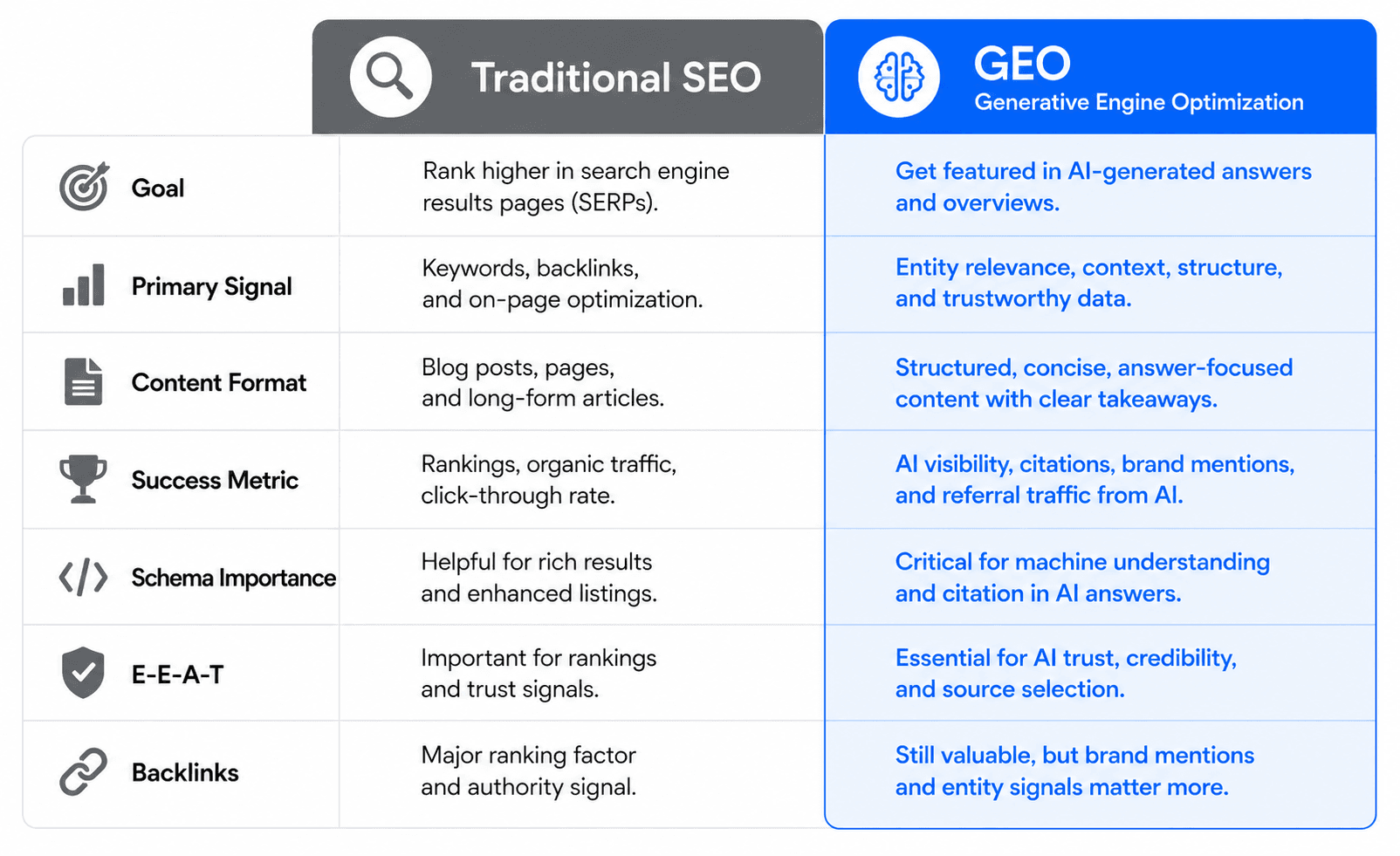
| Dimension | Traditional SEO | Generative Engine Optimisation (GEO) |
|---|---|---|
| Goal | Rank in the list of organic results | Be cited as a source in AI-generated answers |
| Primary signal | Keywords + backlinks + authority | Trustworthiness + structure + direct answers + entity authority |
| Content format | Keyword-optimised articles | Structured, question-answering, directly citable content |
| Success metric | Ranking position + organic traffic | Citation frequency + AI-referred traffic + brand mentions in AI answers |
| Schema importance | Helpful but optional for many | Essential — AI systems rely on structured data for accurate extraction |
| E-E-A-T importance | Important for YMYL niches | Critical for all content types |
| Backlinks | Core ranking signal | Indirect — builds authority that AI systems recognise |
| Content depth | Important | Critical — AI needs comprehensive coverage to cite with confidence |
| Brand mentions | Secondary signal | Primary signal — unlinked brand mentions build AI citation likelihood |
GEO Builds On SEO — It Doesn’t Replace It
The critical point: traditional SEO performance strongly correlates with GEO citation rates. Pages that rank well in organic search are far more likely to be cited in AI Overviews than pages that don’t rank well.
Why? Because AI systems are trained on web data and use ranking quality as a proxy for authority. A page that Google’s algorithm trusts enough to rank on page one is a page that Google’s AI trusts enough to cite.
This means the right strategy is SEO + GEO together — not either/or. Everything you do for traditional SEO builds the foundation for GEO performance. GEO optimisation then adds the structural and trust layers that maximise citation rates on top of that foundation.
3. Why GEO Matters for Your WordPress Site Right Now
Here’s the honest picture: if your WordPress site relies primarily on Google organic search for traffic, your baseline assumption needs to change.
The Zero-Click Problem Is Getting Worse
Zero-click searches — queries where the user gets their answer directly in the search results without clicking through to any website — have been growing for years. Featured snippets, Knowledge Panels, and local packs all reduce click-through rates for organic results.
AI Overviews take this further. When Google’s AI synthesises a complete answer to a query at the top of the results page, a significant portion of users never scroll to the organic results at all. This reduces CTR for all organic positions — even #1.
But here’s the flip side: if your site is cited in that AI Overview, you gain visibility that no traditional organic ranking provides. Your brand appears in the AI answer itself — before any organic result. Users who click your citation link are highly motivated and engaged.
AI Citation Builds Compound Authority
Each time your site is cited in an AI answer, several compounding effects occur:
- Users see your brand name in a trusted context — brand recognition increases
- Branded searches for your site increase over time — a positive ranking signal
- AI systems develop what researchers call “source preference bias” — once a source proves reliable on a topic, the model preferentially cites it again
- Your content is more likely to be included in future AI training data updates — further increasing citation frequency
The early-mover advantage in GEO is real and significant. Sites establishing AI citation authority now are building a compounding asset that will become increasingly difficult for later entrants to match.
GEO Captures New Traffic Sources
Traditional SEO focuses almost exclusively on Google. GEO opens your content to being cited by:
- Google AI Overviews (30–40% of all Google searches)
- Perplexity AI (growing rapidly as a search alternative)
- Microsoft Bing Copilot (integrated with Microsoft’s entire product ecosystem)
- ChatGPT search (hundreds of millions of users globally)
- Claude (Anthropic’s AI, used for research and information finding)
- Apple Intelligence and Siri (increasingly using web citations for answers)
A content piece optimised for GEO isn’t just visible in Google — it’s a candidate for citation across the entire AI search ecosystem. This dramatically expands the addressable audience for every piece of content you publish.
4. How AI Search Engines Choose Their Sources
To optimise for GEO, you need to understand how AI search engines decide which content to cite. The selection process differs from traditional search ranking in important ways.
Retrieval-Augmented Generation (RAG)
Most AI search systems use a technique called Retrieval-Augmented Generation (RAG). When a user asks a question, the system:
- Searches a web index or internal knowledge base for relevant pages
- Retrieves the most relevant passages from multiple sources
- Feeds those passages to the language model as context
- The language model synthesises a response, citing the sources it drew from
This means GEO performance depends on two things: (1) being retrieved as relevant at the search stage, and (2) having your content selected for inclusion in the synthesis at the generation stage.
What Makes Content Selected at the Retrieval Stage?
- Topical relevance — Does the page comprehensively address the query topic?
- Domain authority — Is the site considered an authoritative source in its topic area?
- Recency — Is the content fresh? AI systems prefer recently updated content for time-sensitive queries.
- Structured data — Schema markup helps AI systems correctly categorise and retrieve your content.
- Indexation status — Is the page accessible to AI crawlers? Blocking crawlers blocks GEO visibility.
What Makes Content Selected at the Generation Stage?
- Direct, extractable answers — The AI can pull a clear, complete answer from your content without extensive interpretation
- Source credibility signals — Author credentials, site authority, cited sources within the content
- Content specificity — Specific, precise answers are preferred over vague, general statements
- Factual accuracy — AI systems prioritise content that aligns with established facts and is internally consistent
- Structural clarity — Well-structured content with clear headings and organised information is easier to cite accurately
The Role of Training Data
AI language models are trained on large corpora of web data. Content that was highly cited, linked to, and referenced across the web before the model’s training cutoff is more likely to be in the model’s “memory” — meaning it can be cited even without a web retrieval step. This is why established authority, consistent publishing, and earning organic citations from other sites all contribute to GEO performance.
5. The 8 Core GEO Ranking Signals
Based on research into AI citation patterns and the guidance from Google, Bing, and Perplexity, eight core signals emerge as the most influential for GEO performance.
Signal 1: Authoritative Source Identity
AI systems prioritise known, established sources. The clearer your site’s identity as an authoritative resource in your niche, the more likely it is to be cited. This means:
- A comprehensive, credible About page that establishes who you are and what you cover
- Visible author credentials with verifiable professional backgrounds
- Consistent publishing over time — not sporadic bursts of content
- Organisation schema that connects your WordPress site to a clearly defined entity
Signal 2: Direct Answer Density
Content that contains dense, specific answers to clearly-worded questions is cited at far higher rates than content that circles around answers without stating them directly. AI systems need an extractable answer — a clear, self-contained statement that answers the question in 1–3 sentences.
The formula: Question heading → Direct answer in the first sentence → Supporting context → Evidence.
Signal 3: Structured Content Architecture
AI systems parse structured content more accurately than unstructured prose. Content with clear H2/H3 hierarchies, numbered lists for processes, bullet points for features, and FAQ sections produces more accurate citations than wall-of-text content because the AI can identify and extract specific information without risking misrepresentation.
Signal 4: Schema Markup Coverage
Schema markup is the most direct way to communicate your content’s structure to AI systems. FAQ schema explicitly identifies Q&A pairs. Article schema establishes publication context and authorship. HowTo schema marks up step-by-step processes. Content with comprehensive schema coverage is cited more reliably and more accurately than content without it.
Signal 5: E-E-A-T Signal Strength
Experience, Expertise, Authoritativeness, and Trustworthiness signals directly influence AI citation rates. AI systems — particularly Google’s, which is trained to apply quality guidelines — weight content from identifiable experts on established sites more heavily than anonymous content or content from generic sites.
Signal 6: Content Freshness
AI search systems update their web indices regularly and preferentially cite recently updated content for time-sensitive queries. Content with a clear, accurate “Last Updated” date signal that has been meaningfully refreshed outperforms stale content on the same topic.
Signal 7: Brand Entity Recognition
AI systems develop entity recognition for brands and publications over time. A brand that is consistently mentioned, cited, and referenced across multiple authoritative sources becomes a recognised entity in the AI’s understanding of a topic area. Once established as a trusted entity, citation rates increase organically — this is the “source preference bias” effect.
Signal 8: Topical Completeness
AI systems synthesise answers from multiple sources to provide complete responses. Content that covers a topic comprehensively — including edge cases, common objections, and related sub-topics — is more valuable to the AI because it can be used as a primary rather than supporting source. Thin, surface-level content rarely appears as the primary citation in an AI-generated answer.
6. How to Implement GEO on Your WordPress Site
GEO implementation on WordPress breaks down into four practical layers: content, technical, entity, and authority. Here’s exactly what to do in each.
Layer 1: Content Optimisation for AI Citation
Restructure content around questions
Audit your top 20 most important posts and pages. For each one, identify the primary question each section answers and ensure the section heading states that question explicitly. Then check that the first sentence of each section directly answers that question.
Add direct answer summaries
Add a “Key Takeaways” or “Quick Summary” section at the top of long-form posts. This 3–5 bullet summary gives AI systems a pre-synthesised version of your content’s main points — frequently cited verbatim in AI overviews.
Expand FAQ sections on every major post
Every pillar post and product page should include a FAQ section with 6–10 questions. These should be question-format questions that real users search for — use Google’s “People Also Ask” boxes and AnswerThePublic to find them. Write concise, 50–100 word direct answers to each.
Cite your sources
Content that cites credible external sources (research papers, industry reports, authoritative statistics) is treated as more trustworthy by AI systems. Add citations to factual claims. This doesn’t just help GEO — it improves E-E-A-T signals for traditional SEO too.
Include original data and insights
AI systems actively prefer original data, case studies, and first-hand experience over content that simply summarises what’s available elsewhere. Original research, proprietary data, and expert opinions that can’t be found elsewhere are highly citable.
Layer 2: Technical Implementation
Implement comprehensive schema markup
Every page needs appropriate schema. At minimum:
- Article schema on all blog posts
- FAQ schema on all pages with question-answer content
- HowTo schema on all step-by-step guides
- Organisation schema on your homepage and About page
- Person/Author schema on author pages
- Product schema on all product pages
Ensure AI crawler access
Check your robots.txt file to confirm you are not blocking AI crawlers. Google’s main crawler (Googlebot) handles AI Overviews. For other AI systems, ensure you’re not blocking GPTBot (OpenAI), ClaudeBot (Anthropic), PerplexityBot, or BingBot.
Fix all technical SEO foundations
Pages with technical SEO issues (crawl errors, slow load times, mobile issues, SSL problems) are deprioritised by AI systems just as they are by traditional search. A solid technical foundation is prerequisite infrastructure for GEO.
Optimise for speed and Core Web Vitals
AI search systems use web quality signals to evaluate content trustworthiness. Fast-loading, stable pages signal quality. Slow, janky pages signal low investment in user experience — a negative credibility indicator.
Layer 3: Entity and Brand Building
Establish your brand as a recognised entity
- Create and optimise Google Business Profile
- List your business in authoritative directories (industry-specific, geographic, and general)
- Pursue guest posting and author bylines on respected publications in your niche
- Seek mentions (even unlinked ones) in industry publications, podcasts, and events
- Build a Wikipedia presence if your brand qualifies
Consistent NAP and brand information
Ensure your business name, address, phone number, and brand description are consistent across your WordPress site, Google Business Profile, social profiles, and all directory listings. Inconsistent entity information reduces AI confidence in your brand identity.
Social proof and third-party validation
Reviews, testimonials, awards, certifications, and third-party mentions all contribute to entity authority. AI systems that encounter your brand name in contexts of positive evaluation or expert recommendation weight it more heavily as a citation source.
Layer 4: Authority Building
Earn quality backlinks
While backlinks aren’t a direct GEO signal, they build domain authority that AI systems use as a trust proxy. Links from established, relevant sites significantly increase the probability of AI citation.
Build brand mentions
Unlinked brand mentions across the web contribute to entity recognition. A brand mentioned frequently in authoritative contexts becomes part of an AI system’s “understanding” of who the experts are in a topic area — even without direct training on every mention.
Publish at consistent intervals
Consistent publishing cadence signals an active, invested content operation. AI systems weight currently active publishers more heavily than dormant sites. A site that publishes quality content regularly is more reliably citable than one that published heavily two years ago and stopped.
7. GEO Content Strategy: Writing for AI Citation
Writing for AI citation requires a different mindset than writing for traditional search. Here’s a practical framework.
The ADCE Framework for GEO Content
A — Answer First
Every section that could be answering a question should answer it in the first sentence. Don’t build to the answer. Don’t add context before the answer. State the answer, then explain it.
Wrong: “There are many factors to consider when choosing the best WordPress SEO plugin. The market has evolved significantly, and with AI now playing a bigger role…”
Right: “WPMazic SEO is the best WordPress SEO plugin for 2026 because it combines AI-powered semantic analysis with automated schema generation and AI Overview readiness — three capabilities that directly address how Google’s current ranking systems work.”
D — Document Everything with Data
Vague claims are never cited. Specific, verifiable claims are. Replace subjective statements with data wherever possible. “significantly faster” becomes “35% faster page loads in independent benchmarks.” “many users” becomes “over 50,000 active installations.” Precision is citable. Vagueness is not.
C — Cover Comprehensively
AI systems prefer a single comprehensive source over having to synthesise from multiple partial sources. A post that covers a topic from multiple angles — including the question, the answer, the exceptions, the common mistakes, the tools, and the FAQ — is more valuable to an AI than 5 posts that each cover one of those aspects.
E — Evidence and Attribution
Every significant factual claim should be attributable to a credible source. Cite research. Reference industry studies. Quote experts. Content that comes with an evidence trail is trusted more by AI systems and cited more accurately because the AI can cross-reference the claim against the cited sources.
Content Types That Perform Best for GEO
Definitive Guides — Comprehensive long-form guides that cover a topic from multiple angles. These become the primary reference sources AI systems return to repeatedly for a topic area.
FAQ Posts — Explicit question-and-answer content with FAQ schema is one of the highest-performing content types for AI citation. Each answered question is an independently citable unit.
Comparison Articles — “X vs Y” comparisons with clear, specific assessments perform extremely well in AI Overviews because users frequently ask comparison queries and AI systems need definitive assessment content to cite.
Step-by-Step Tutorials — Process content with HowTo schema is highly citable because AI systems can reproduce the steps accurately with the schema’s explicit structure.
Original Research and Data — Proprietary data, surveys, case studies, and original research are exceptionally citable because they can’t be found elsewhere. AI systems seek original data sources for claims that require evidence.
Glossaries and Definitions — Content that clearly defines industry terms, concepts, and technologies is frequently cited in AI responses because users regularly ask “what is” queries that require definitional answers.
8. Schema Markup: The Technical Foundation of GEO
Schema markup is arguably the single most impactful technical action you can take for GEO. It’s the bridge between your content and the AI’s ability to accurately extract, understand, and cite it.
Why Schema Is More Important for GEO Than for Traditional SEO
Traditional SEO uses schema primarily for rich results — those visual enhancements in Google’s search results like star ratings, FAQ boxes, and recipe cards. These are valuable for click-through rates but aren’t always directly tied to rank position.
For GEO, schema serves a more fundamental purpose: it tells the AI system what your content is. Without schema, the AI has to infer whether a section of text is an answer to a specific question, a step in a process, a product description, or a general explanation. With schema, that classification is explicit. Explicitly classified content is cited more reliably and more accurately.
The GEO Schema Priority Stack
Priority 1: FAQ Schema
Every page with question-answer content should have FAQ schema. This is the most direct GEO signal — it explicitly identifies which text is the answer to which question, making your content the perfect format for AI systems to cite when a user asks that question.
Priority 2: Article / BlogPosting Schema
Establishes publication context, authorship, and temporal relevance. Critical for E-E-A-T signal propagation in AI systems.
Priority 3: Person / Author Schema
Connects your content to identifiable, credible human authors. In an era of AI-generated content proliferation, human authorship with verifiable credentials is increasingly valuable as a trust signal.
Priority 4: HowTo Schema
For any step-by-step content. Creates explicitly structured process content that AI systems can reproduce accurately.
Priority 5: Organisation Schema
Establishes your brand as a recognised entity with verifiable identity information. Critical for building the entity authority that compounds GEO performance over time.
Priority 6: Product Schema
For WooCommerce sites — product schema with accurate, current data is essential for eCommerce GEO. AI shopping assistants and AI-powered product recommendation features rely on structured product data.
Implementing Schema Without Writing Code
Manual JSON-LD schema writing is error-prone and time-consuming. WPMazic SEO automates schema generation for all priority types — detecting content patterns and generating valid, well-formed schema automatically. For FAQ sections, WPMazic SEO detects question-answer pairs and creates FAQ schema without any manual input. For step-by-step guides, HowTo schema is generated automatically. For all posts, Article schema with correct authorship and publication data is created on save.
This automation is crucial for GEO at scale. Manually adding schema to hundreds of existing posts is impractical. WPMazic SEO handles the entire schema layer systematically across your content library.
9. Entity SEO: Making Your Brand AI-Discoverable
Entity SEO is one of the most important — and most underestimated — components of GEO. Here’s why it matters and how to implement it.
What Is an Entity in AI Search?
In AI search systems, an entity is a real-world object, person, organisation, or concept that can be distinguished from other things. Google’s Knowledge Graph contains billions of entities and the relationships between them. AI search systems use entity recognition to understand who is talking about what, which sources are authoritative on which topics, and which brands to trust for which types of information.
When your WordPress site is a well-defined entity — with consistent identity signals across multiple platforms — AI systems can confidently cite it because they “know” who you are. When your site is poorly defined as an entity, AI systems are less likely to cite it because the identity signal is weak.
Building Entity Authority for GEO
Create a Knowledge Panel-worthy brand identity
- Your WordPress site needs a clear, consistent brand name used identically across all platforms
- The same logo, brand description, and contact information should appear on your site, Google Business Profile, social profiles, and directory listings
- Your Organisation schema should include all social profile URLs, your logo, and official contact information
Establish topical entity authority
AI systems recognise entities not just by name but by topic area. “WPMazic” needs to be recognised as an authority on WordPress SEO — not just as a brand name. This requires consistent content publishing within your topic area, being cited by other authoritative sources in that area, and having your brand associated with specific topics in as many contexts as possible.
Pursue strategic brand mentions
Every mention of your brand in an authoritative context — a podcast interview, a guest post, an industry newsletter, a press mention — contributes to entity recognition. Even unlinked mentions are valuable for GEO because AI systems can identify entity references without requiring a hyperlink.
10. E-E-A-T and GEO: The Trust Layer
Google’s E-E-A-T framework — Experience, Expertise, Authoritativeness, and Trustworthiness — was originally developed for traditional search quality evaluation. For GEO, it has become even more critical because AI systems need to make high-confidence decisions about source reliability before including content in AI-generated answers.
Experience Signals for GEO
Show that your content comes from someone who has genuinely done the thing they’re writing about:
- Include first-person accounts of relevant experiences (“When I migrated a 10,000-post site to WPMazic SEO…”)
- Add original screenshots, examples, and case study data from your own work
- Show the messy reality alongside the polished result — AI systems recognise genuine experience through specificity and nuance that generic content lacks
Expertise Signals for GEO
- Every post should have a visible author byline with a link to an author page
- Author pages should include professional credentials, publication history, professional profiles, and areas of expertise
- Implement Person schema on author pages connecting the author to the topics they cover
- Link to the author’s external profiles (LinkedIn, industry publications, professional memberships)
Authoritativeness Signals for GEO
- Backlinks from established sites in your niche remain the strongest authority signal
- Being cited, quoted, or referenced by other authoritative content creators
- Speaking at industry events or being a podcast guest on respected shows
- Having your research or data cited by others (original research earns citations naturally)
Trustworthiness Signals for GEO
- Factual accuracy — content that contains verifiable, accurate claims
- Transparent corrections — when errors are found and corrected visibly, this actually increases trust
- Clear business identity — who runs the site, how to contact them, what their privacy practices are
- Secure, well-maintained site infrastructure — HTTPS, no malware, fast loading
- Consistent brand voice across a long publication history
11. How to Measure GEO Performance
GEO measurement is less mature than traditional SEO analytics — the tooling is still developing — but there are concrete ways to track your progress.
Google Search Console Signals
While Search Console doesn’t have a dedicated GEO report, you can infer AI Overview performance:
- Impression spikes without proportional click increases — When impressions surge but CTR drops, AI Overviews are likely appearing for your keywords and answering the query without requiring a click
- Near-zero position appearances — Pages consistently appearing at Position 0 are strong AI Overview citation candidates
- Rich result appearances in Performance data — Tracking which of your pages generate rich results in search
Manual GEO Checking
The most direct method: search your target keywords in Google (incognito), Perplexity, Bing, and ChatGPT search. Note:
- Is an AI Overview appearing for this query?
- Is your site cited in the AI Overview?
- Which competitors are being cited?
- What content format are the cited pages using?
Document these findings in a tracking spreadsheet and repeat monthly for your 20 most important target queries.
Third-Party GEO Tracking Tools
The following tools now include GEO tracking features as of 2026:
- SEMrush — AI Overview tracking feature monitors which keywords trigger overviews and which domains are cited
- SE Ranking — AI Overview tracker with citation monitoring
- Authoritas — Dedicated GEO tracking and citation visibility monitoring
- BrightEdge — Enterprise-level AI search visibility tracking
GEO KPIs to Track
- Number of target queries where your site is cited in AI Overviews
- AI-referred traffic (Google Analytics 4 → Traffic Acquisition → filter for AI referral sources)
- Brand search volume trend (increasing brand searches indicate growing entity recognition)
- Schema coverage percentage across your content library
- Rich result appearances (Search Console → Search Appearance)
- Citation appearances in ChatGPT, Perplexity, and Bing AI (manual tracking)
12. How WPMazic SEO Makes GEO Implementation Easy on WordPress
Implementing GEO manually — schema for every page, content restructuring, entity configuration — is a substantial undertaking on a large WordPress site. WPMazic SEO systematises the entire GEO implementation layer, turning what would be weeks of manual work into a continuous automated process.
Automated Schema Generation at Scale
WPMazic SEO’s AI engine analyses every page and post on your site and automatically generates appropriate schema markup:
- FAQ schema detected and generated from question-answer content patterns
- Article schema with accurate authorship, publication, and temporal data on all posts
- HowTo schema for step-by-step tutorial content
- Product schema synced with WooCommerce data for all product pages
- Organisation and LocalBusiness schema on site-level pages
- Person schema on author pages
Schema is validated on every save — catching errors before they affect search appearance. This is the most direct and impactful technical GEO action available, and WPMazic SEO does it automatically.
GEO Content Readiness Scoring
WPMazic SEO analyses every post for GEO readiness — evaluating:
- Direct answer positioning (are answers at the top of sections or buried?)
- Question-answer structure (are there explicit Q&A sections?)
- Semantic completeness (does the content cover the topic comprehensively?)
- E-E-A-T signal strength (author attribution, source citations, credentials)
- Content freshness signals (last updated date, temporal accuracy)
The GEO readiness score is displayed alongside the traditional SEO score in the editor — giving you a complete picture of how well-positioned each piece of content is for both traditional search and AI citation.
Entity Configuration Made Simple
WPMazic SEO’s setup wizard walks you through configuring your site’s entity information — Organisation schema, author profiles, social profiles, contact information, and brand description — in a structured interface that generates correct JSON-LD without requiring any technical knowledge. This entity configuration becomes the foundation for all GEO-relevant structured data across your entire site.
Site Health Monitoring for GEO Prerequisites
WPMazic SEO’s continuous site health monitoring ensures the technical prerequisites for GEO remain in place:
- Crawler access confirmed — no accidental AI crawler blocks in robots.txt
- Indexation health — all GEO-target pages properly indexed
- SSL status — trust signal maintained
- Core Web Vitals — performance quality signals kept above threshold
- Schema validity — all structured data passing Google’s requirements
AI Overview Readiness Dashboard
WPMazic SEO’s dashboard includes an AI Overview readiness tracker that shows:
- Which posts and pages have AI-ready content structure
- Which pages are missing schema that would improve GEO performance
- Which pages have declining freshness signals and need content updates
- Aggregate GEO readiness score across your entire content library
This dashboard replaces the need for manual GEO auditing — surfacing the most impactful improvement opportunities automatically.
13. Common GEO Mistakes WordPress Sites Make
Blocking AI crawlers in robots.txt
Some site owners add overly broad disallow rules that accidentally block AI crawlers like GPTBot, PerplexityBot, or ClaudeBot. If these crawlers can’t access your content, you can’t be cited in those AI systems. Check your robots.txt carefully.
No FAQ sections on key pages
FAQ sections with schema markup are the highest-performing GEO content format. Sites without them on their most important pages are leaving the most direct GEO opportunity on the table.
Anonymous content with no author attribution
Content with no visible author, no author bio, and no author schema is treated as lower-trust by AI systems. In 2026, anonymous content is a significant GEO disadvantage. Every piece of content should have a credentialed author visibly attributed.
Optimising for traffic light scores instead of AI citation readiness
Sites still focused on green Yoast scores are optimising for a metric that doesn’t predict GEO performance. A green Yoast score doesn’t mean AI-ready content. WPMazic SEO’s GEO readiness score is a more relevant target.
Thin content on high-intent pages
AI systems prefer comprehensive sources. A 400-word product page or a 600-word blog post rarely gets cited. High-intent pages — those targeting commercial or informational queries that trigger AI Overviews — need to be comprehensive enough for an AI to choose them as its primary source.
Inconsistent brand information across platforms
Entity authority requires consistency. Different brand names, different contact information, different descriptions across your website, Google Business Profile, social platforms, and directories create entity ambiguity that reduces AI citation confidence.
Never updating content
Stale content loses GEO performance to fresher competitors. AI systems actively filter for recent content on time-sensitive queries. A regular content refresh cadence — particularly for your most important pages — is essential for maintaining GEO visibility.
Treating GEO as separate from SEO
GEO and SEO are not competing strategies — they’re complementary. The technical foundations of SEO (crawlability, speed, schema, authority) are prerequisites for GEO. Sites that abandon traditional SEO in favour of a “GEO-only” approach undermine the authority signals that make GEO citations possible.
14. The Future of GEO: Where This Is All Heading
GEO is not a passing trend. It’s the structural consequence of AI becoming the dominant interface for information discovery. Understanding where it’s heading helps you build a strategy that remains relevant not just in 2026 but over the next 5–10 years.
AI Search Will Capture More of the Market
The trajectory is clear. Google AI Overviews are expanding to more query types and more countries. ChatGPT’s search functionality is improving rapidly. Perplexity is growing as a standalone search alternative. Apple Intelligence is integrating AI answers across iOS and macOS. The percentage of information discovery that happens through AI-generated responses will continue to grow.
Sites that build GEO authority now compound their advantage over time. Sites that wait until AI search dominates will face a much more competitive environment for establishing entity recognition and citation authority.
Multimodal GEO
Current GEO is primarily text-based. But AI search systems are becoming multimodal — processing images, video, and audio alongside text. Content that pairs high-quality, structured text with original images, diagrams, and video creates a richer citation target across multiple modalities.
For WordPress site owners, this means investing in original visual content that is schema-marked (ImageObject, VideoObject) and contextually connected to your text content.
Personalised AI Responses
AI search systems are increasingly personalising responses based on user history, location, and preferences. This creates opportunities for content that addresses highly specific audiences, local contexts, and niche use cases — areas where large, generic publishers are less competitive.
AI Commerce
Google, OpenAI, and Perplexity are all developing AI-powered shopping experiences where AI systems recommend and facilitate product purchases directly within the AI interface. For WooCommerce stores, this makes product schema, brand entity recognition, and review data even more critical — they become inputs to AI purchase recommendation systems.
The Commoditisation of AI-Generated Content
As AI content generation becomes cheaper and more prevalent, the differentiating value of original, expert, experience-driven content will increase. AI systems will need to increasingly distinguish between human-authored expert content and AI-generated filler — and trust signals, original data, and clear authorship credentials will be the primary differentiators.
Sites that invest in genuine expertise and original insight now are building a sustainable competitive advantage that becomes more valuable as AI-generated content floods the web.
15. Frequently Asked Questions
What does GEO stand for in SEO?
GEO stands for Generative Engine Optimisation — the practice of optimising content to be cited as a source in AI-generated responses from platforms like Google AI Overviews, ChatGPT, Perplexity, and Microsoft Copilot. It is also called Answer Engine Optimisation (AEO) or Large Language Model Optimisation (LLMO).
Is GEO replacing traditional SEO?
No. GEO builds on traditional SEO — it doesn’t replace it. Strong traditional SEO performance (high organic rankings, domain authority, technical foundations) is a prerequisite for GEO success because AI systems use ranking quality as a proxy for content trustworthiness. The right approach is SEO + GEO together, where each reinforces the other.
How do I know if my WordPress site is appearing in AI search results?
Search your target keywords manually in Google (incognito mode), Perplexity, and Bing to check if AI Overviews appear and whether your site is cited. In Google Search Console, watch for impression spikes without proportional click increases — a common signal of AI Overview appearances. Third-party tools like SEMrush and SE Ranking now include AI Overview tracking features.
What is the most important thing I can do for GEO on my WordPress site today?
Add FAQ schema to your top 10 most important posts and pages. FAQ schema explicitly marks question-answer pairs for AI extraction, making your content one of the most direct GEO signals available. Combined with writing direct answers at the top of each section, this single improvement can measurably increase AI citation rates within weeks of Google re-crawling your updated content.
Does WPMazic SEO help with GEO?
Yes, significantly. WPMazic SEO is the only major WordPress SEO plugin with GEO-specific features — including automated schema generation for all priority GEO schema types, a GEO readiness score for every post, AI Overview readiness monitoring, and continuous technical health checks for the prerequisites of AI citation. It makes systematic GEO implementation on WordPress practical without requiring technical expertise.
How long does it take to see GEO results?
Technical GEO improvements like schema addition can produce results within 2–4 weeks as AI crawlers re-index your updated pages. Content structure improvements typically show results within 4–8 weeks. Entity authority building and topical coverage expansion are longer-term investments that compound over 3–12 months. GEO — like traditional SEO — rewards consistency over time rather than one-time fixes.
Should I be worried about AI crawlers indexing my content?
For most sites, AI crawlers accessing your content is beneficial — it’s how you get cited in AI-generated answers. If you have strong concerns about your content being used without appropriate citation, you can add specific directives to your robots.txt for specific AI crawlers. However, blanket AI crawler blocking will reduce your GEO visibility significantly.
What content types perform best for GEO?
FAQ posts, definitive guides, comparison articles, original research, step-by-step tutorials, and glossaries all perform well for GEO. Content with explicit FAQ schema, HowTo schema, and direct answer formatting at the top of each section consistently outperforms unstructured content for AI citation across all query types.
16. Conclusion
Generative Engine Optimisation isn’t the future of search. It’s the present — and the sites that adapt their WordPress SEO strategy for AI citation now are already building a compounding advantage over those that haven’t.
The good news: GEO doesn’t require starting over. It builds on everything you’ve already invested in traditional SEO — the authority, the content, the technical foundations. What it adds is a layer of structure, schema, and trust signalling that makes your existing content more citable by AI systems.
For WordPress site owners, the implementation path is clear:
- Restructure key content around direct-answer question-heading format
- Add FAQ, Article, HowTo, and Organisation schema comprehensively
- Build clear author attribution with verifiable credentials
- Ensure AI crawlers have full access to your content
- Build brand entity recognition through consistent presence and external mentions
- Publish at a consistent cadence and refresh top content regularly
The tooling that makes this practical at scale is WPMazic SEO — with automated schema generation covering all GEO-critical schema types, a GEO readiness score for every post, AI Overview monitoring, and continuous technical health checks that ensure the prerequisites for AI citation are always in place.
GEO is expected to eclipse traditional SEO as the primary driver of online visibility by 2027. The sites that are already being cited by AI engines today will be the established authorities when that transition completes.
Start building your GEO presence today. The compounding effects of early action in AI search are real — and the window for first-mover advantage is still open.
Get WPMazic SEO and start building your GEO foundation today →