
Article Guide
Use these jump points to move through the article faster.
Search is changing.
For many years, people searched for something on Google, looked through a list of search results, opened several websites, compared the information, and then decided which answer was useful.
That behavior is changing quickly.
Today, people can ask an AI system a complete question and receive a direct answer.
Instead of searching for:
“best SEO plugins for WordPress”
A user may ask:
“What is the best SEO plugin for a WordPress website?”
Or:
“Which WordPress SEO plugin is good for beginners?”
Or:
“Compare the best WordPress SEO plugins for a WooCommerce store.”
AI systems can understand the question, find relevant information, compare different sources, and generate an answer.
This new search behavior creates a new challenge for website owners.
Ranking on traditional search engines is still important, but it is no longer the only goal.
Your website should also be easy for AI systems to understand, trust, retrieve information from, and potentially mention or cite.
This is where Generative Engine Optimization, commonly called GEO, becomes important.
In this guide, we will explain GEO in very simple language, how it is different from traditional SEO, why it matters, how AI search works, and what website owners can do today to improve their AI search visibility.
What Is Generative Engine Optimization?
Generative Engine Optimization (GEO) is the process of improving website content and online presence so that generative AI and AI-powered search systems can better understand, retrieve, summarize, reference, and potentially recommend that information.
In simple words:
SEO helps search engines understand your website and rank your pages.
GEO helps AI-powered search systems understand your website and use your information when generating answers.
GEO does not replace SEO.
Instead, GEO should be considered an extension of modern SEO.
A strong website should be optimized for:
- Search engines
- Users
- AI systems
- Accessibility
- Structured data
- Knowledge systems
- Different search experiences
The goal is not simply to “rank higher.”
The goal is to become a useful, trustworthy, and understandable source of information.
Why Is GEO Becoming Important?
The biggest change is how people search.
Traditional search usually works like this:
User → Search Engine → Search Results → Website → Answer
AI-powered search can work more like this:
User → AI Search → Retrieved Information → Generated Answer → Sources
This changes the role of your website.
A user may not click through ten different search results.
Instead, they may receive a summarized answer from an AI system.
For businesses, this creates both an opportunity and a challenge.
If your website is included in the information used to generate an answer, you may gain additional visibility.
If your website is ignored, your competitors may receive that visibility instead.
For example, imagine someone asks:
“What are the best SEO tools for WordPress?”
An AI-generated answer may mention several products.
The user may then research the products that were mentioned.
This means brand visibility inside AI-generated answers can become an important part of digital marketing.
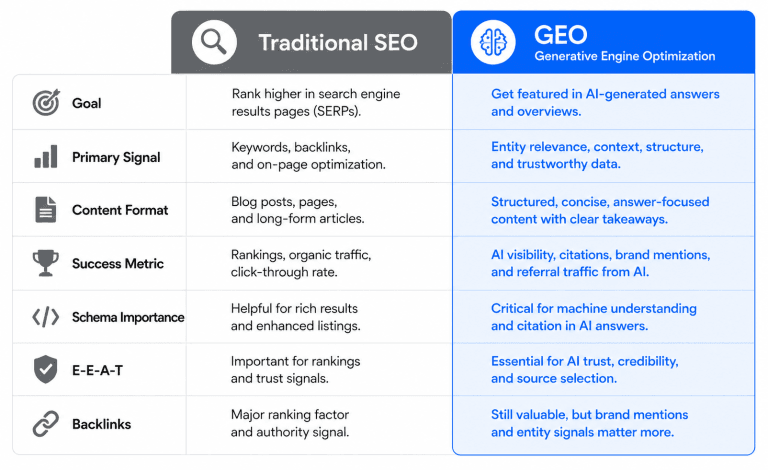
GEO vs SEO: What Is the Difference?
SEO and GEO are closely connected, but they are not exactly the same.
Traditional SEO focuses heavily on search engine visibility.
GEO focuses on visibility within generative and AI-powered search experiences.
| Traditional SEO | GEO / AI Search Optimization |
|---|---|
| Focuses on search engine rankings | Focuses on AI search visibility |
| Keywords are important | Questions, topics, and entities are important |
| Backlinks are important | Authority and trusted references are important |
| Optimizes search snippets | Optimizes information for AI retrieval |
| Targets search results | Targets AI-generated answers |
| Technical SEO matters | Technical SEO still matters |
| Content quality matters | Content clarity and factual consistency matter |
| Search intent matters | Conversational intent and user questions matter |
The important thing to understand is that GEO is not a completely separate marketing system.
Good SEO is still the foundation of good GEO.
A technically broken website will not become successful simply because you add AI-related content.
How Does AI Search Work?
AI search systems are much more complicated than simple keyword matching.
Different platforms use different technologies and algorithms, so there is no single universal GEO ranking formula.
However, a simplified process can look like this:
Step 1: The User Asks a Question
For example:
“What is the best SEO plugin for WordPress?”
Step 2: The System Understands the Question
The AI tries to understand:
- What the user wants
- The topic
- Search intent
- Important entities
- Context
- Possible related questions
Step 3: Relevant Information Is Retrieved
Depending on the platform and search experience, the system may use information from web pages, indexed documents, databases, knowledge sources, and other available information.
Step 4: Information Is Evaluated
The system attempts to determine which information is relevant and useful for the user’s question.
Step 5: An Answer Is Generated
The AI creates an answer using the information available to it.
Step 6: Sources May Be Displayed
Some AI search experiences provide citations or links to sources.
This is one of the important reasons GEO matters.
Your website should provide information that is clear enough for AI systems to understand and useful enough to be selected as a source.
The Most Important GEO Principle: Write for Humans First
One of the biggest mistakes businesses can make is creating content that is designed only for AI.
Do not write strange content just because you believe an AI system might like it.
People are still the most important audience.
Your content should be:
- Clear
- Useful
- Accurate
- Easy to read
- Well organized
- Specific
- Original
- Helpful
If your content is genuinely useful to people, it can also provide a strong foundation for search engines and AI systems.
Avoid unnecessary keyword stuffing.
Avoid repeating the same sentence in ten different ways.
Avoid writing paragraphs that do not provide useful information.
Good GEO starts with good content.
1. Create Clear and Direct Answers
AI systems need to understand what your page is about.
One effective approach is to answer important questions directly.
What Is GEO?
Generative Engine Optimization is the process of improving a website’s content and online presence so AI-powered search systems can better understand, retrieve, and reference its information.
That answer is:
- Short
- Direct
- Clear
- Easy for humans to understand
- Easy to identify as an answer
You can then provide more details below it.
This approach is useful for FAQ sections, guides, tutorials, and educational content.
2. Build Topic Authority
One article is rarely enough to establish strong authority around a large topic.
Suppose your business is related to WordPress SEO.
Instead of publishing only one article called “WordPress SEO Guide”, you can build a complete topic cluster.
- WordPress SEO basics
- Technical SEO for WordPress
- WordPress schema markup
- WooCommerce SEO
- WordPress Core Web Vitals
- Internal linking
- XML sitemaps
- Robots.txt
- SEO titles
- Meta descriptions
- Image SEO
- Local SEO
- AI SEO
- GEO
- Content optimization
- SEO audits
- SEO reporting
These pages can connect to each other through relevant internal links.
This creates a stronger topical structure and gives users multiple ways to explore the subject.
3. Focus on Questions, Not Only Keywords
Traditional SEO often starts with keywords.
GEO should also consider questions.
People naturally ask AI systems complete questions.
Examples include:
- How do I improve WordPress SEO?
- What is schema markup?
- How can I make my website more visible in AI search?
- Which SEO plugin is best for WooCommerce?
- What is the difference between SEO and GEO?
These questions can become content opportunities.
A useful GEO strategy should identify:
- Questions
- Problems
- Comparisons
- Definitions
- How-to searches
- Product searches
- Alternative searches
- Troubleshooting searches
- Industry questions
Then create genuinely useful answers.
4. Use Clear Headings
Well-structured content is easier to read and easier to understand.
Use clear headings such as:
- What Is GEO?
- Why Does GEO Matter?
- How Does AI Search Work?
- SEO vs GEO
- How to Optimize Your Website for GEO
- GEO Mistakes to Avoid
- GEO Checklist
Clear headings create a logical structure.
They also help users quickly find the information they need.
5. Use Structured Data
Structured data helps search engines understand the meaning of information on a page.
Depending on the page, useful schema types may include:
- Article
- BlogPosting
- Organization
- Product
- SoftwareApplication
- LocalBusiness
- FAQPage
- HowTo
- BreadcrumbList
- Review
Schema should always accurately represent the content.
Do not add schema simply because you want to manipulate search results.
The information in your structured data should match the visible and factual information on your page.
6. Strengthen Your Entity
An entity is a clearly identifiable person, organization, company, product, place, or concept.
For example, if WPMazic has a product called WPMazic SEO, it should be consistently represented across its website and other legitimate online sources.
Important information may include:
- Product name
- Company name
- Official website
- Product description
- Features
- Documentation
- Pricing
- Authors
- Organization information
- Social profiles
- Reviews
Consistency matters.
If different websites describe the same product using completely different names or information, understanding the entity becomes more difficult.
7. Build Brand Authority
GEO is not only about your website.
Your overall online presence matters.
Your brand may be mentioned on:
- Industry websites
- News websites
- WordPress communities
- Software directories
- Review websites
- Developer websites
- Podcasts
- Interviews
- Social platforms
- Community discussions
- Partner websites
The quality and relevance of these references matter more than simply collecting thousands of random mentions.
Do not think:
“How can I create 10,000 mentions?”
Think:
“How can I become a trusted source in my industry?”
That is a much healthier long-term strategy.
8. Publish Original Information
AI systems have access to a huge amount of existing information.
If your article simply repeats information that already exists on hundreds of websites, there may be little reason for users to choose your content.
Try to add something original.
For example:
- Original research
- Product testing
- Case studies
- Real examples
- Industry statistics
- Expert opinions
- Comparisons
- Screenshots
- Experiments
- Performance tests
- Practical tutorials
Original information can make your content more valuable.
9. Keep Information Consistent
Imagine your website says:
“WPMazic SEO supports Feature A.”
But another trusted page says:
“WPMazic SEO does not support Feature A.”
Conflicting information can create confusion.
Important business information should be reviewed regularly.
This includes:
- Product features
- Pricing
- Company information
- Documentation
- Compatibility
- Product versions
- Integrations
- Contact information
- Author information
Keeping information consistent is useful for both users and machines.
10. Keep Content Fresh
AI search often deals with questions where freshness matters.
For example:
- WordPress versions
- SEO practices
- AI search
- Software features
- Pricing
- Security recommendations
- Web standards
A guide published several years ago may contain information that is no longer correct.
Review important content regularly.
Add:
- Last updated date
- New examples
- Updated screenshots
- Current product information
- New references
- New recommendations
Do not change dates just to make old content appear fresh.
Actually update the content.
11. Create Strong Internal Linking
Internal links help users navigate your website.
They also help search systems understand relationships between pages.
For example, a GEO article could link to:
- WordPress SEO guide
- Schema guide
- Internal linking guide
- AI content optimization guide
- Technical SEO guide
This creates a connected information architecture.
Avoid adding links simply for the sake of adding links.
Use meaningful anchor text.
Instead of:
“Click here”
use:
“Learn how to optimize WordPress schema markup.”
12. Make Content Easy to Scan
Long articles do not have to be difficult to read.
Use:
- Short paragraphs
- Lists
- Tables
- Examples
- Headings
- Bold important concepts
- Definitions
- FAQs
- Step-by-step instructions
This helps users quickly understand the article.
It also creates clearly separated pieces of information.
13. Use Author Information
Trust is important for many topics.
Consider adding an author profile containing:
- Name
- Job role
- Experience
- Expertise
- Author page
- Relevant credentials
- Published articles
Only make claims that are true.
The goal is transparency, not artificial authority.
14. Create Comparison Content
Comparison searches are very common.
People ask:
- Rank Math vs Yoast
- WordPress SEO plugin comparison
- Best SEO plugin for WooCommerce
- SEO plugin alternatives
Comparison pages can be useful GEO assets because they provide structured information.
When creating comparison content:
- Be honest
- Explain differences
- Mention strengths and weaknesses
- Avoid unsupported claims
- Keep information current
- Clearly explain who each option is best for
Trust is more valuable than aggressive promotion.
15. Create FAQ Content
FAQs are useful when users have common questions about a topic.
Is GEO replacing SEO?
No. GEO does not replace traditional SEO. It extends SEO practices to address the growing role of generative and AI-powered search experiences.
Does GEO guarantee that ChatGPT will mention my website?
No. There is no reliable way to guarantee that an AI system will mention or cite a particular website.
Do backlinks still matter?
Traditional authority signals and references remain important, but GEO should not be reduced to backlinks alone.
Is AI-generated content automatically good for GEO?
No. AI-generated content can still be inaccurate, repetitive, or unhelpful. Quality, accuracy, originality, and usefulness are more important than whether content was written by a human or assisted by AI.
GEO and AI-Generated Content
AI can be extremely useful for content creation.
But there is an important difference between AI-generated content and high-quality content created with AI assistance.
AI can help with:
- Research organization
- Outlines
- Ideas
- Content briefs
- Rewriting
- Summaries
- FAQ discovery
- Content analysis
- Grammar
- Optimization
But humans should still review important content.
Always check:
- Facts
- Statistics
- Links
- Claims
- Product information
- Technical details
- Examples
Do not publish large amounts of automatically generated content without quality control.
More content does not automatically mean more visibility.
GEO Does Not Mean Keyword Stuffing With AI Terms
Adding words such as:
- ChatGPT SEO
- AI SEO
- Generative Engine Optimization
- AI search
hundreds of times will not magically improve your visibility.
Use relevant terminology naturally.
Write for the actual question.
For example, if the user wants to understand GEO, explain GEO.
Do not repeat phrases such as “GEO SEO AI optimization” in every paragraph.
Natural language is better.
GEO for WordPress Websites
WordPress websites have a major advantage because they provide a flexible platform for content, structured data, internal linking, and technical SEO.
A WordPress GEO strategy can include:
- Clean website architecture
- Fast performance
- Mobile-friendly design
- Good technical SEO
- Structured data
- Strong internal linking
- Author information
- High-quality content
- FAQ sections
- Product documentation
- Consistent entity information
- XML sitemaps
- Proper indexing controls
- Image optimization
- Content freshness
A WordPress SEO plugin can help website owners manage many of these areas from one place.
However, no plugin can guarantee AI citations.
Plugins can improve the technical and content foundation.
The actual AI visibility depends on many external factors.
GEO for SaaS Companies
SaaS companies should think beyond product landing pages.
Create content around the problems your software solves.
For example, instead of only publishing:
“Our software features”
also publish:
- How to solve a specific problem
- Product comparisons
- Best tools for a specific use case
- How to automate a process
- Implementation guides
- Common mistakes
- Checklists
- Templates
- Case studies
This gives AI systems and users more useful information about your expertise.
GEO for E-commerce Websites
E-commerce businesses can also benefit from GEO.
Product information should be clear, accurate, structured, detailed, and current.
Include:
- Product name
- Brand
- Features
- Specifications
- Compatibility
- Use cases
- Price where appropriate
- Availability
- Reviews
- FAQs
For products with many variations, make sure each important variation is understandable.
GEO for Local Businesses
Local businesses should maintain consistent information across their digital presence.
Important information includes:
- Business name
- Address
- Phone number
- Opening hours
- Services
- Areas served
- Reviews
- Website
- Business category
Local SEO remains extremely important.
GEO adds another layer because users can ask AI systems questions such as:
- Find a good SEO agency near me.
- What are some good restaurants in Ahmedabad?
- Which dentist is recommended in my area?
The AI system needs reliable information to provide useful local answers.
GEO and Reviews
Reviews can influence how people perceive a business.
They can also contribute to the overall online presence of a brand.
Encourage genuine customers to provide honest feedback.
Do not:
- Buy fake reviews
- Generate fake customer experiences
- Create fake testimonials
- Manipulate ratings
Trust is difficult to build and easy to lose.
GEO and Backlinks
Backlinks remain an important part of SEO.
But GEO should not be treated as:
“Get backlinks and AI will recommend you.”
It is much more complicated.
A better approach is to earn relevant references from trustworthy websites.
For example, a WordPress product mentioned by respected WordPress publications, developers, and industry websites may gain stronger authority than a product with thousands of low-quality directory links.
Quality is more important than quantity.
GEO and Digital PR
Digital PR can become increasingly valuable.
If your company publishes something genuinely interesting, industry websites may mention it.
Examples include:
- Original research
- Industry reports
- Product innovations
- Technical research
- Useful statistics
- Expert commentary
- Case studies
These references can increase brand awareness and authority.
How to Measure GEO?
This is one of the most difficult parts.
Traditional SEO provides metrics such as:
- Rankings
- Impressions
- Clicks
- CTR
- Organic traffic
GEO requires additional measurements.
You can track:
- Brand mentions in AI answers
- Citation frequency
- Citation sources
- Accuracy of AI descriptions
- Product mentions
- Competitor mentions
- Questions where your brand appears
- Questions where your brand is missing
- AI referral traffic where measurable
- Sentiment
- Share of AI visibility
Create a list of important questions for your business.
For example:
- What is the best WordPress SEO plugin?
- What is the best SEO plugin for beginners?
- What is the best WooCommerce SEO plugin?
- What are alternatives to popular SEO plugins?
- Which WordPress plugin supports a specific feature?
Then periodically test these questions across relevant AI search platforms.
Record the results.
Do not treat one AI response as permanent.
AI answers can change.
GEO Visibility vs Traditional Rankings
A website can rank well on Google and still have limited visibility in an AI answer.
Likewise, a website may receive AI visibility for a question where it does not rank first traditionally.
This is why businesses should monitor both.
Think of your search strategy as having multiple surfaces:
- Traditional search
- AI search
- Maps
- News
- Video
- Social
- Communities
- Industry websites
Modern search visibility is becoming more distributed.
Common GEO Mistakes
Mistake 1: Believing GEO Is a Magic Trick
There is no secret GEO button.
No plugin, prompt, or schema property can guarantee AI visibility.
Mistake 2: Publishing Thousands of AI Articles
More content is not automatically better.
Low-quality content can create a large website without creating real authority.
Mistake 3: Keyword Stuffing
Repeating AI-related keywords does not make content authoritative.
Mistake 4: Ignoring Technical SEO
If search engines cannot properly crawl and understand your website, GEO becomes harder.
Mistake 5: Creating Fake Brand Mentions
Fake reviews, fake profiles, and artificial mentions can damage trust.
Mistake 6: Forgetting Humans
AI is important, but your customers are still humans.
Write content that people actually want to read.
Mistake 7: Not Updating Content
Old pricing, old screenshots, and outdated recommendations reduce trust.
A Practical GEO Checklist
Technical SEO
- Website is crawlable
- Important pages are indexable
- XML sitemap is available
- Robots.txt is configured correctly
- Website works on mobile
- Pages load quickly
- HTTPS is enabled
- Broken links are fixed
- Canonical URLs are correct
- Structured data is implemented correctly
Content
- Content directly answers user questions
- Headings are clear
- Paragraphs are easy to read
- Important facts are clearly stated
- Content is original
- Content is regularly reviewed
- Articles include useful examples
- FAQs answer real questions
- Internal links connect related topics
Entity
- Company name is consistent
- Product names are consistent
- About page is complete
- Author information is available
- Organization information is clear
- Product information is accurate
- Important external profiles are consistent
Authority
- Earn relevant backlinks
- Build industry relationships
- Publish original research
- Get genuine reviews
- Participate in relevant communities
- Build legitimate brand mentions
AI Visibility
- Identify important customer questions
- Test AI search results
- Monitor brand mentions
- Monitor competitor mentions
- Check AI-generated descriptions
- Identify missing questions
- Update content based on genuine gaps
The Future of GEO
Search is not disappearing.
It is evolving.
People will continue to use traditional search engines, but they are also becoming comfortable asking complete questions to AI systems.
The future may involve a combination of:
- Search engines
- AI assistants
- Conversational search
- Voice search
- Shopping assistants
- AI agents
- Personalized recommendations
This means websites need to become more understandable.
A website should not simply contain keywords.
It should clearly communicate:
- Who you are
- What you offer
- Who your product is for
- What problems you solve
- How your product works
- Why people trust you
- What makes you different
That information creates a stronger digital identity.
GEO Is About Becoming the Best Answer
This may be the most important idea in the entire GEO discussion.
Do not start with:
“How do I make AI mention my website?”
Start with:
“How can I create the most useful answer to this question?”
If your website consistently provides:
- Accurate information
- Original insights
- Clear explanations
- Useful examples
- Strong documentation
- Real expertise
- Trusted references
- Excellent user experience
you are building the type of online presence that can perform well across many search environments.
The goal is not to trick AI.
The goal is to become useful enough that your information deserves to be found.
Final Thoughts
Generative Engine Optimization is still developing.
There is no universal GEO formula that guarantees a website will appear in every AI-generated answer.
AI platforms use different systems, data sources, and retrieval methods.
That means businesses should avoid anyone promising guaranteed ChatGPT rankings or guaranteed AI citations.
Instead, focus on the fundamentals.
Create excellent content.
Make your website technically strong.
Answer real questions.
Build topical authority.
Use structured data correctly.
Keep business information consistent.
Build genuine brand authority.
Publish original information.
Keep important content updated.
And most importantly, create content that is genuinely useful to people.
SEO helped websites become visible in search engines.
GEO represents the next step in making information understandable and useful in an increasingly AI-driven search environment.
For WordPress website owners, the opportunity is significant.
The businesses that start preparing now can build a stronger foundation for the way people discover information in the future.
GEO is not about replacing SEO.
It is about preparing your website for a world where search is becoming more conversational, intelligent, and answer-driven.
GEO Quick Summary
GEO = Generative Engine Optimization
Primary goal: Improve the chances that AI-powered search systems can understand, retrieve, reference, and accurately represent your website or brand.
Focus on:
- Helpful content
- Clear answers
- Topical authority
- Entity consistency
- Structured data
- Technical SEO
- Original research
- Internal linking
- Brand authority
- Content freshness
- User experience
- AI visibility monitoring
Remember:
SEO helps your website become discoverable in search.
GEO helps prepare your information for AI-powered discovery and answers.
Great content is the foundation of both.
Frequently Asked Questions About GEO
What does GEO stand for in SEO?
GEO stands for Generative Engine Optimization. It refers to optimizing content and online presence for generative AI and AI-powered search experiences.
Is GEO the same as SEO?
No. GEO and SEO overlap, but they have different focuses. SEO traditionally focuses on visibility in search engines, while GEO focuses on visibility and representation within AI-powered search and answer experiences.
Does GEO replace traditional SEO?
No. Traditional SEO remains important. Technical SEO, content quality, links, crawlability, and search intent still provide an important foundation.
Can GEO guarantee a ChatGPT citation?
No. There is no reliable way to guarantee that an AI system will cite or recommend a specific website.
Does AI-generated content help GEO?
AI can help with content research, organization, and production, but automatically generated content is not automatically high quality. Accuracy, usefulness, originality, and human review remain important.
What is the most important GEO factor?
There is no single factor that guarantees AI visibility. A strong combination of useful content, authority, clear information, technical accessibility, entity consistency, and genuine online references provides a better foundation.
Is schema markup important for GEO?
Structured data can help search engines and other systems understand the meaning and relationships of information on a website. It should always accurately represent the visible content.
Should I create a separate GEO page on my website?
You can create a GEO guide to explain the topic, but GEO should not be limited to one page. The entire website should have a clear information architecture and strong content foundation.
How can I measure GEO performance?
You can create a set of important questions and periodically monitor whether your brand, products, or content appear in relevant AI-generated answers. You can also monitor citations, mentions, competitors, and AI referral traffic where measurable.
Is GEO useful for WordPress websites?
Yes. WordPress websites can benefit from GEO principles such as high-quality content, structured data, strong internal linking, technical SEO, clear entity information, and well-organized documentation.
Want to Improve Your WordPress SEO and AI Visibility?
Building a strong foundation for traditional SEO and AI search starts with good technical SEO, useful content, structured information, and a well-organized website.
WPMazic provides WordPress SEO solutions designed to help website owners manage important SEO tasks and improve their overall search optimization workflow.
Explore WPMazic and discover tools for improving your WordPress SEO strategy.